Key Takeaways
- Sediment in water is one of the most common compliance risks on industrial job sites, driving turbidity exceedances, fines, and work stoppages.
- Passive settling alone rarely keeps up with fluctuating industrial water volumes, so proactive sediment control is essential.
- TigerFloc is a natural, mineral-based flocculant that binds fine particles into heavier flocs for faster, more reliable water clarification.
- Portable, scalable TigerFloc systems adapt to construction, mining, and oil sands sites without permanent infrastructure.
- A site-specific sediment management plan lowers regulatory exposure while protecting uptime and budget.
- Floc Systems Inc., based in Surrey, Canada, supplies TigerFloc flocculant products throughout Canada and the United States.
Managing sediment in water is one of the toughest daily challenges on industrial job sites. Excavation, material handling, equipment washing, and yard runoff all generate turbid water, often faster than passive settling can clear it. When that water misses discharge limits, operators face inspection findings, fines, and costly downtime. Because industrial sites run continuously and water volumes shift throughout the day, sediment control has to be both consistent and adaptable. TigerFloc, a natural mineral-based flocculant from Floc Systems Inc., helps operators clarify sediment-laden water quickly and cost-effectively. This guide explains why sediment in water is a compliance risk and how a structured sediment management plan keeps industrial projects productive and within permit.
Why Sediment in Water Is a Compliance Risk on Industrial Job Sites
Sediment in water is a compliance risk because it raises turbidity above permitted discharge limits, and regulators can respond with monitoring orders, penalties, or stop-work directives. Different sites produce different sediment profiles, but the underlying challenge is the same: fine particles must be removed from water before it leaves the site.
What Causes High Turbidity on Industrial Sites?
Turbidity, the cloudiness caused by suspended solids, is typically measured in Nephelometric Turbidity Units (NTU), while permits may also cap Total Suspended Solids (TSS) in mg/L. Manufacturing and maintenance sites generate fine particulates from raw-material handling and yard runoff, while pipeline and energy projects manage trenching runoff and temporary storage water. Fine clay and silt are the hardest to remove: because the particles are so small and lightly charged, they can stay suspended for hours, well beyond what passive settling ponds can clear when flow rates spike.
How Sediment Problems Lead to Fines and Downtime
Discharge standards remain in effect regardless of production pressure. Without adequate clarification, sites risk inspection findings, additional monitoring requirements, and in more serious cases, temporary operational adjustments or stop-work orders. Each of these carries a direct cost: regulatory penalties, added labour and lab testing, and lost production while crews wait for water to clear. Proactive sediment control is far cheaper than reactive remediation, which is why a documented sediment management plan is now standard practice on well-run industrial sites.
How TigerFloc Improves Sediment Control and Water Clarification
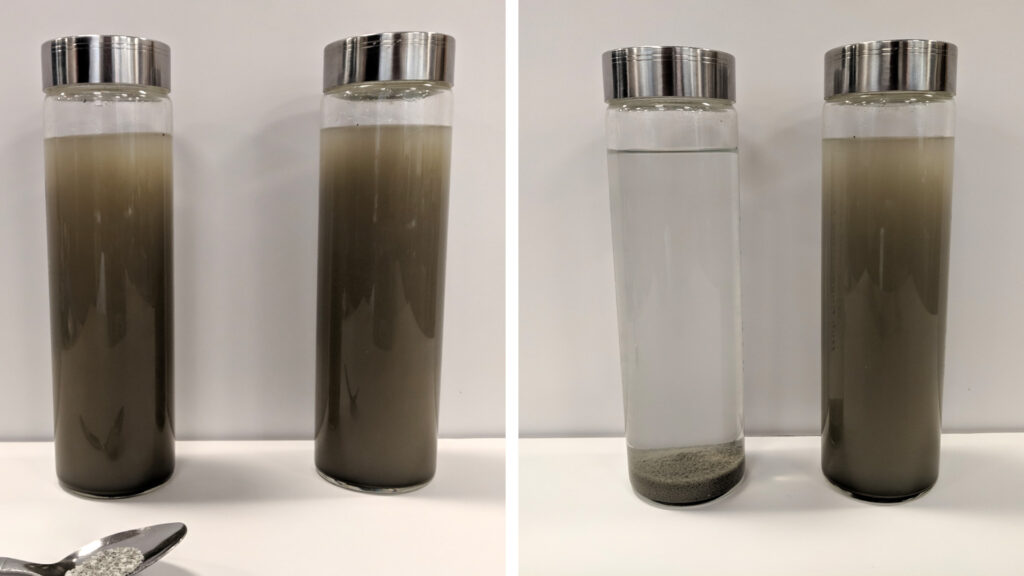
TigerFloc improves sediment control by binding fine suspended particles into heavier flocs that settle far faster than they would on their own, turning slow, unreliable settling into predictable clarification. It is natural, fast to deploy, and cost-effective, which is why it fits the variable conditions of industrial work. You can see the full process on the Floc Systems how it works page.
A Natural, Mineral-Based Flocculant
TigerFloc is formulated from naturally occurring mineral-based components and designed for field-deployable use across industrial environments. Rather than relying on heavy permanent infrastructure, it integrates into portable treatment configurations that supplement your existing passive settling systems, strengthening sediment management without redesigning the site.
Fast, Field-Deployable Sediment Control
Portable treatment lets crews address water right at the collection point. Turbid water is pumped through flocculant belts housed in layflat tubing and directed into dewatering bags, where sediment is retained and clarified water is released. This modular setup can be repositioned or scaled as work areas shift. Explore the full range of wastewater treatment solutions to match a configuration to your site.
Cost-Effective Compliance
Because TigerFloc systems are compact and portable, they deliver effective sediment control within constrained footprints and reduce the need for extensive infrastructure on temporary or seasonal projects. Applied with proper dosage planning, including jar testing where required, treatment can be optimized for specific water conditions to reduce the likelihood of sediment exceedances. For dosing and system design, the wastewater treatment team can help you plan around your water chemistry and flow rates.
Sediment Management Across Different Industrial Use Cases
Effective sediment management looks different in each sector because the sediment source and water volume change. The table below summarizes how sediment control priorities shift across common industrial job sites.
| Industrial Sector | Typical Sediment Source | Sediment Control Priority |
| Construction & infrastructure | Excavation, trenching runoff, dewatering | Meeting turbidity limits before discharge to storm drains or waterways |
| Mining & aggregate | Wash water, process water, tailings-adjacent runoff | Continuous clarification under high, fluctuating volumes |
| Oil sands & energy | Pipeline trenching, temporary storage water | Field-deployable treatment across remote, phased work areas |
Construction and Infrastructure
Excavation, trenching, and dewatering generate suspended solids that must be clarified before discharge to storm drains or nearby waterways. Portable TigerFloc systems let crews treat water at each active work area and reposition equipment as the project phases forward.
Mining and Aggregate
Wash water and process water carry high, fluctuating sediment loads. Passive ponds provide foundational control, but flocculant-based treatment helps maintain consistent clarification when volumes surge, supporting continuous operation without breaching turbidity limits.
Oil Sands and Energy
Pipeline trenching and temporary storage water often occur across remote, phased work areas where permanent treatment infrastructure is impractical. Field-deployable TigerFloc configurations bring sediment control to the water, wherever the work is. Floc Systems Inc. is based in Surrey, Canada, and TigerFloc flocculant products are available throughout Canada and the United States, so operators working across multiple jurisdictions can standardize their sediment management approach. You can request a demo to see the system in action on your site conditions.
Strengthen Sediment Control With Floc Systems Inc.
Floc Systems Inc. helps industrial teams turn sediment control from a compliance headache into a predictable, budget-friendly part of operations. Based in Surrey, Canada, our company designs practical water clarification strategies around your site's real conditions (volume, footprint, and discharge requirements) using TigerFloc natural flocculant products available throughout Canada and the United States.
Whether you are managing trenching runoff, process water, or yard runoff, we can help you build a sediment management plan that protects uptime and keeps you within permit. Ready to strengthen sediment control on your next project? Contact Floc Systems Inc. to ask a question, request a demo, or get a TigerFloc fact sheet.
Frequently Asked Questions
Sediment in water is suspended soil, clay, silt, and fine particles picked up during excavation, material handling, or runoff. On industrial job sites it raises turbidity above permitted discharge limits, which can trigger inspection findings, fines, and downtime until the water is clarified.
A sediment management plan is a site-specific strategy that identifies where sediment-laden water is generated, how it will be captured and treated, and how discharge will be monitored. It usually combines passive settling with active sediment control, such as TigerFloc flocculant, to meet regulatory limits consistently.
TigerFloc is a natural, mineral-based flocculant that binds fine suspended particles into heavier flocs so they settle faster. Used with dewatering bags, flocculant belts, and layflat tubing, it clarifies turbid water at the collection point without large permanent infrastructure.
Construction and infrastructure, mining and aggregate, and oil sands and energy operations all use TigerFloc to manage trenching runoff, process water, and yard runoff. Portable systems scale to each site's water volume and available footprint.
Floc Systems Inc. is based in Surrey, Canada, and supplies TigerFloc flocculant products throughout Canada and the United States.
Table of Contents
If you have questions or concerns about turbidity, sediment, or freshwater demand on your project,
you may reach out to Floc Systems Inc., a water treatment company in Surrey, Canada.
Our team of professional biologists and QEPs supports projects across Canada and the United States.

0 Comments