
Key Takeaways
- Turbid water is one of the most common triggers for discharge violations, failed inspections, and stop-work orders on active job sites.
- Fluctuating water volumes from rainfall, excavation, and dewatering can overwhelm passive controls and push turbidity past permitted limits.
- A temporary water treatment system built around TigerFloc natural flocculant clarifies water in minutes and scales up or down with site conditions.
- Field and lab testing shows turbidity dropping from 500 NTU to 8 NTU and pollutants falling from roughly 200 PPM to 10 to 15 PPM.
- TigerFloc is non-toxic and biodegradable, made from natural clay minerals and silica-based coagulants, and is available throughout Canada and the United States.
Turbid water is a persistent compliance headache on construction, mining, and industrial sites. When rainfall, excavation, or dewatering push water volumes higher, suspended sediment climbs and discharge can quickly exceed permitted turbidity limits. The result is often failed inspections, monitoring flags, stop-work orders, and fines that stall project timelines. Managing this risk depends on a water treatment system that reacts as fast as site conditions change. TigerFloc, a natural flocculant from Floc Systems Inc., gives crews a field-deployable way to clarify turbid water on demand, hold discharge within limits, and keep work moving. This guide breaks down the most common compliance challenges in turbid water management and the practical ways to address them.
Turbidity, Regulations, Fines, and Downtime
Turbid water becomes a compliance problem when suspended solids raise turbidity above the limits written into a site's discharge permit. High turbidity is an indirect measure of how much sediment is in the water, so regulators use it as a fast indicator of whether on-site controls are actually working. When readings spike, so does scrutiny.
How Fluctuating Water Volumes Increase Compliance Risk
Water accumulation on active job sites is rarely steady. Heavy rainfall can overwhelm collection areas within hours, deeper excavation can expose groundwater that increases daily pumping requirements, and shifting grading changes where runoff collects. As these water volumes move and multiply, sediment-laden water often outpaces the capacity of the controls in place.
Passive systems such as settling ponds are useful, but they are not always designed for sudden spikes in flow. When volumes exceed capacity, clarification efficiency drops and discharge can fall out of compliance with sediment and solids limits. Inspections during high-flow periods frequently lead to corrective measures, additional monitoring, or temporary discharge restrictions that slow the whole project down.
Regulations and the Real Cost of Non-Compliance
Discharge rules are strict on both sides of the border. In Canada, subsection 36(3) of the federal Fisheries Act prohibits depositing a deleterious substance into water frequented by fish, and sediment-laden runoff can fall under that prohibition. Enforcement is active, and penalties from Environment and Climate Change Canada have reached into the hundreds of thousands of dollars for unauthorized deposits, including cases in British Columbia'sFraser River. In the United States, the EPA's NPDES stormwater program and its Construction General Permit require operators to control sediment and, in many cases, to conduct turbidity benchmark monitoring for dewatering discharges.
The direct cost of a violation is only part of the picture. Downtime is often the larger expense: stop-work orders, remobilization, delayed handovers, and the reputational risk that follows a public enforcement notice. A water treatment system that keeps discharge inside the limits is therefore a schedule protector as much as an environmental one.
How TigerFloc Solves It: A Fast, Natural, Cost-Effective Water Treatment System
TigerFloc binds suspended particles, hydrocarbons, and debris into heavy flocs that settle in minutes, turning turbid water into clear water ready for compliant discharge or reuse. The four-step process is simple enough to run in the field:
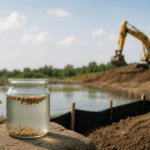
- Test the water. A quick jar test identifies turbidity and contaminants so the correct dosage can be calculated.
- Add TigerFloc. Apply the recommended dosage into the contaminated water.
- Mix and bind. Agitation or pumps activate coagulation, binding particles and hydrocarbons into heavy flocs.
- Settle and discharge. The flocs sink, leaving clear water ready for release.
The performance is measurable. In field and lab testing, TigerFloc has reduced turbidity from 500 NTU to 8 NTU in about 60 seconds at a 1 g/L dose, and cut pollutants from roughly 200 PPM to 10 to 15 PPM. Because it is made from natural clay minerals and silica-based coagulants, TigerFloc is non-toxic, biodegradable, and safe for aquatic life, which makes it suitable even in eco-sensitive areas. Compared with traditional coagulants, it achieves faster clarity at a lower dosage without the compliance concerns tied to some synthetic chemistries.
How Common Treatment Approaches Compare
| Factor | Passive settling ponds only | Synthetic coagulants (e.g. PAM) | TigerFloc natural flocculant |
|---|---|---|---|
| Clarification speed | Hours to days | Minutes, with careful dosing | Minutes (500 NTU to 8 NTU) |
Turbidity reduction | Limited during high flow | Effective when dosed precisely | High and repeatable in testing |
Dosage control | Not applicable | Narrow safe window | Guided by jar testing |
Aquatic safety | Neutral if contained | Overdose and residual concerns | Non-toxic, biodegradable, aquatic-safe |
Scaling with water volumes | Fixed capacity | Requires equipment and monitoring | Modular belts, bags, and pumps |
Compliance risk in spikes | Higher | Moderate | Lower |
Exact results depend on each site's water profile, which is why jar testing is recommended before scaling any deployment.
Scaling a Temporary Water Treatment System for Higher Flow Rates
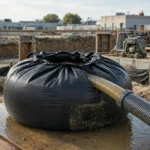
When water volumes rise, a temporary water treatment system needs to scale without new permanent infrastructure. TigerFloc is built for exactly this. Turbid water is pumped through flocculant belts housed in layflat tubing, then directed into dewatering bags where sediment is retained and clarified water is released.
To handle higher flow, crews can:
- Add more flocculant belts and socks at the treatment point.
- Increase pump flow rates within safe operating limits.
- Expand the number of dewatering bags in use.
This modular approach lets teams respond to changing runoff levels in real time. A ready-to-deploy TigerFloc Water Treatment Kit and the full product range make it straightforward to right-size treatment as conditions shift, and a demo request can confirm the setup on your specific water before mobilizing at scale.
Maintaining Efficiency During Low-Volume Periods
Adapting to changing water volumes also means scaling down. During dry spells or late project phases, runoff drops and idle equipment simply wastes budget. Portable TigerFloc systems can be repositioned as work zones move or collection points shift, so crews treat only what needs treating.
Right-sizing dosage keeps this efficient. As a benchmark, 1 lb of TigerFloc treats roughly 200 gallons of contaminated water, so a 50 lb bag handles about 10,000 gallons. Confirming dosage with a jar test avoids overuse and keeps cost per treated volume predictable across both high and low demand.
Industry Use Cases: A Water Treatment System Built for Canadian and US Sites

TigerFloc is field-tested across the sectors where turbid water and tight discharge limits collide. For teams comparing water treatment system options in Canada and the United States, the same natural flocculant adapts across very different applications.
Construction and Pipeline Projects
Earthworks, trenching, and cement washout generate heavy sediment loads that fluctuate with every storm. TigerFloc has been deployed on a 300 km pipeline project to treat over one million liters of runoff, clarifying water at collection points so discharge stayed compliant while construction continued.
Mining and Reclamation
Mining and reclamation sites often sit in eco-sensitive watersheds where metals and fine solids raise both turbidity and regulatory attention. Because TigerFloc is non-toxic and biodegradable, it supports sediment control in these zones without introducing chemistries that create their own compliance problems.
Oil Sands and Tailings Ponds
Oil sands and tailings applications combine hydrocarbons, suspended solids, and large volumes. TigerFloc binds solids and hydrocarbons into settleable flocs, helping operators manage high-volume process water and move it toward compliant handling or reuse.
Beyond these, TigerFloc supports stormwater management, agricultural runoff, lagoons, and industrial process water cleanup. You can review more success cases and the full range of solutions to match the approach to your site.
Based in Surrey, British Columbia, Floc Systems Inc. is staffed by professional biologists and Qualified Environmental Professionals, and its team helps design treatment plans tailored to each project. TigerFloc flocculant products are available throughout Canada and the United States.
Talk to Floc Systems Inc.
Floc Systems Inc. helps project teams turn turbid, non-compliant water into clear water that meets discharge requirements without slowing the schedule. From a single collection point to a high-volume, multi-bag setup, the team designs scalable treatment around your actual water profile and provides jar-test guidance so you dose accurately from day one. Whether you manage a construction site, a mining reclamation area, or an oil sands operation in Canada or the United States, TigerFloc offers a fast, eco-safe way to stay compliant and control costs. To size a temporary water treatment system for your site, contact Floc Systems Inc. for a fact sheet or quote.
FREQUENTLY ASKED QUESTIONS
Turbid water fails compliance when suspended solids raise turbidity above the limits set in a site's discharge permit. This usually happens when water volumes spike after rainfall, excavation, or dewatering and overwhelm passive controls such as settling ponds. Because turbidity is an easy, fast indicator of sediment, high readings often prompt inspections, corrective action, or discharge restrictions.
TigerFloc works in minutes. In testing, it reduced turbidity from 500 NTU to 8 NTU in about 60 seconds at a 1 g/L dose and cut pollutants from roughly 200 PPM to 10 to 15 PPM. Actual timing depends on your water profile, which a quick jar test confirms before full deployment.
Yes. A temporary water treatment system using TigerFloc scales by adding flocculant belts, increasing pump flow within safe limits, and expanding the number of dewatering bags. When runoff drops, the same portable equipment can be scaled back or repositioned, so you treat only what the site produces and keep costs in line.
Dosage is set with a jar test that measures your water's turbidity and contaminants. As a benchmark, 1 lb of TigerFloc treats about 200 gallons of contaminated water, and a 50 lb bag handles roughly 10,000 gallons. The Floc Systems team provides jar-test guidance and dosage recommendations, and you can request a demo to confirm performance on your water.
TigerFloc flocculant products are supplied from Surrey, British Columbia and are available throughout Canada and the United States. You can browse the full product range online or contact Floc Systems Inc. to discuss a specific application. Additional answers are on the FAQ page.
If you are looking to reduce downtime and keep discharge within limits as site water volumes change,
you may reach out to Floc Systems Inc., a water treatment company in Surrey, Canada.
Our team of professional biologists and QEPs supports projects across Canada and the United States.


0 Comments